


Roles: Level & Game Designer
Tasks: Layout, Blocking, Level Scripting & 3C, Level Design Document, High Concept Document
Spyglass is a first-person immersive sim set in an alternate steampunk 19th century London, heavily inspired by the Thief series by Looking Glass Studios. It was created for my 2nd year Personal Portfolio Project at Game Sup, for which I created and documented the would-be 2nd mission of the game.
PRE-PRODUCTION


Reference Gathering
After deciding on the game’s main themes and general atmosphere, I quickly started exploring potential inspirations and seeking reference of 19th century Britain as the goal was to try and sell a gritty, mostly true to life era-accurate London.
Finding photos helped inform the base architecture and scale, as gathering personal screenshots of stealth games, especialy from the Thief series, informed the high contrast between light and shadow as well as the general flow of the level.
Setting Intentions
Knowing what environments felt exciting to explore, I wanted to affirm intentions and guidelines that would support sneaking around a tense, night urban environment falling under the control of vicious enemies and cutthroats.
Choosing kidnapping and evidence collecting as main objectives helped cement the level as an early mission, an introduction to the game’s world and building up tension and the plot’s conspiracy. I knew early on that I’d focus on a rather small play area and wanted to focus on playstyles and different approaches in order to reach the objective.
LEVEL FLOW & LAYOUT
Flow
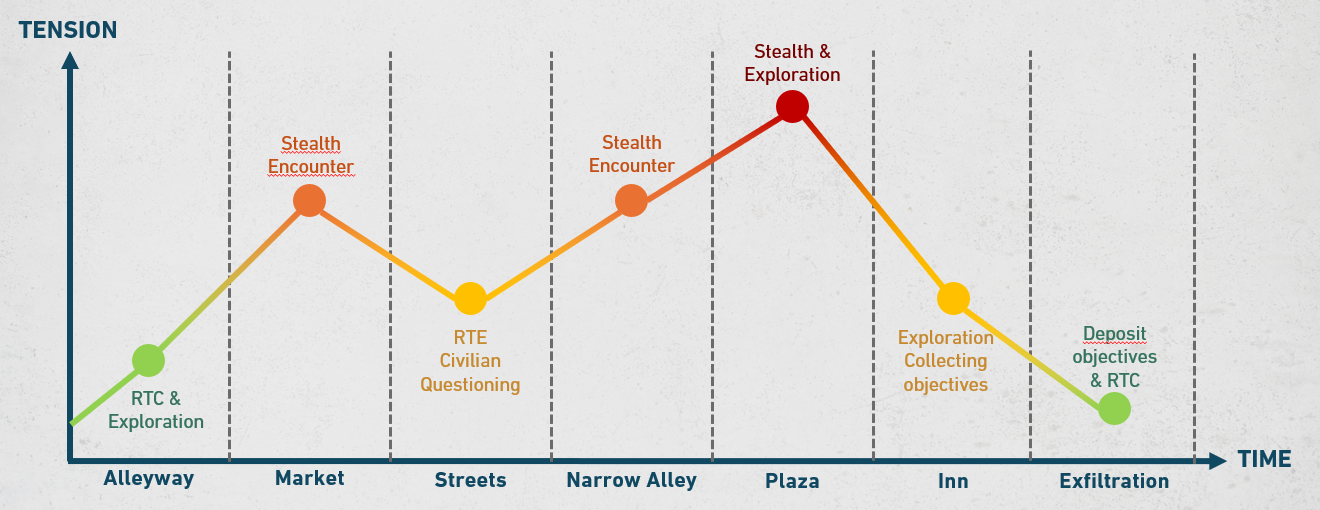
After figuring out a rough idea of level progression and gameplay beats, I assembled them into a graph to map out the pacing throughout the mission and made sure to leave some breathing space for the player to recover and observe.
This also gave me an idea of where and when scripted scenes would play out, as well as inform enemy and light placement.
Final Draft
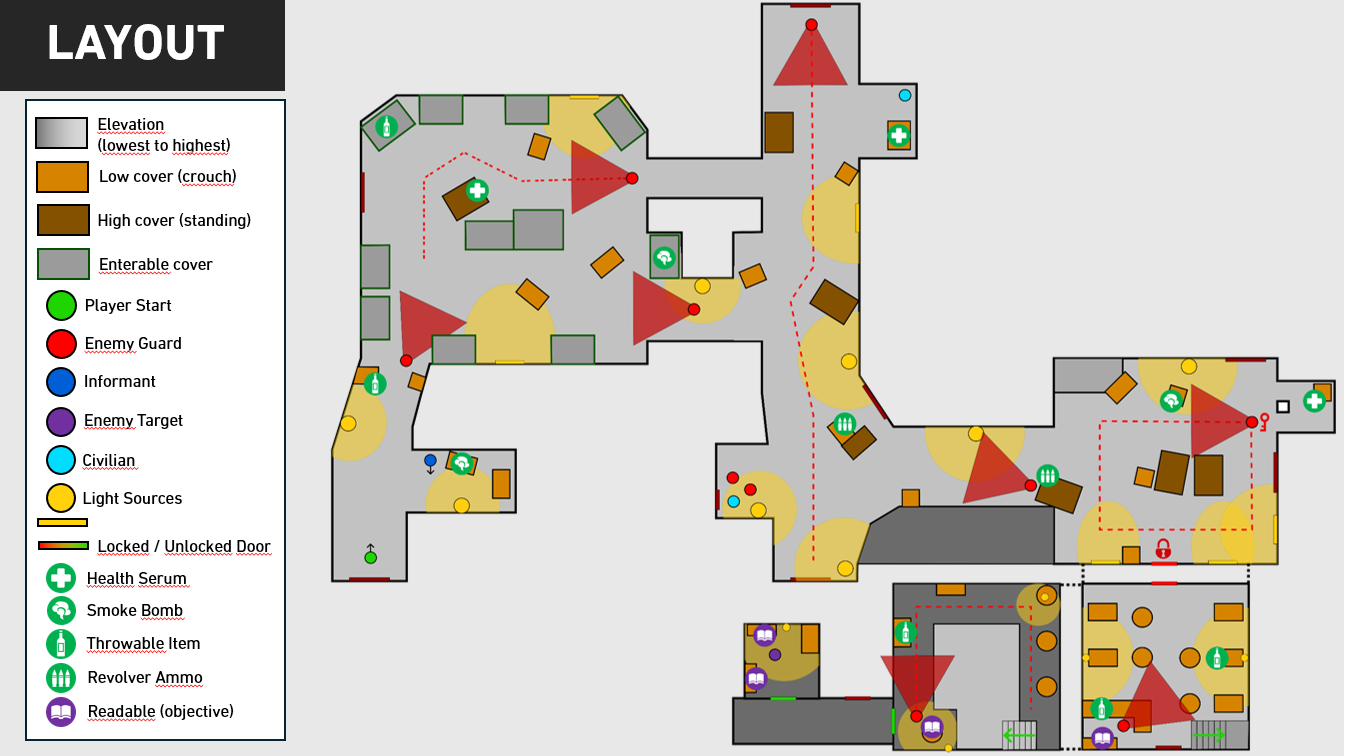
Having mapped out a rough play space and general volumes inside the engine to get a feel for the level (see below), I created a legible layout that focuses on enemy patrols, light zones and item / readable / objective placement while keeping in mind the general level shape and elevation.
I tried keeping to a simple, clean finish for the final draft reminiscent of map overviews in Prima Guides that I’d glaze over as a teen as well as Counter-Strike map radars.
BLOCKOUT PROCESS
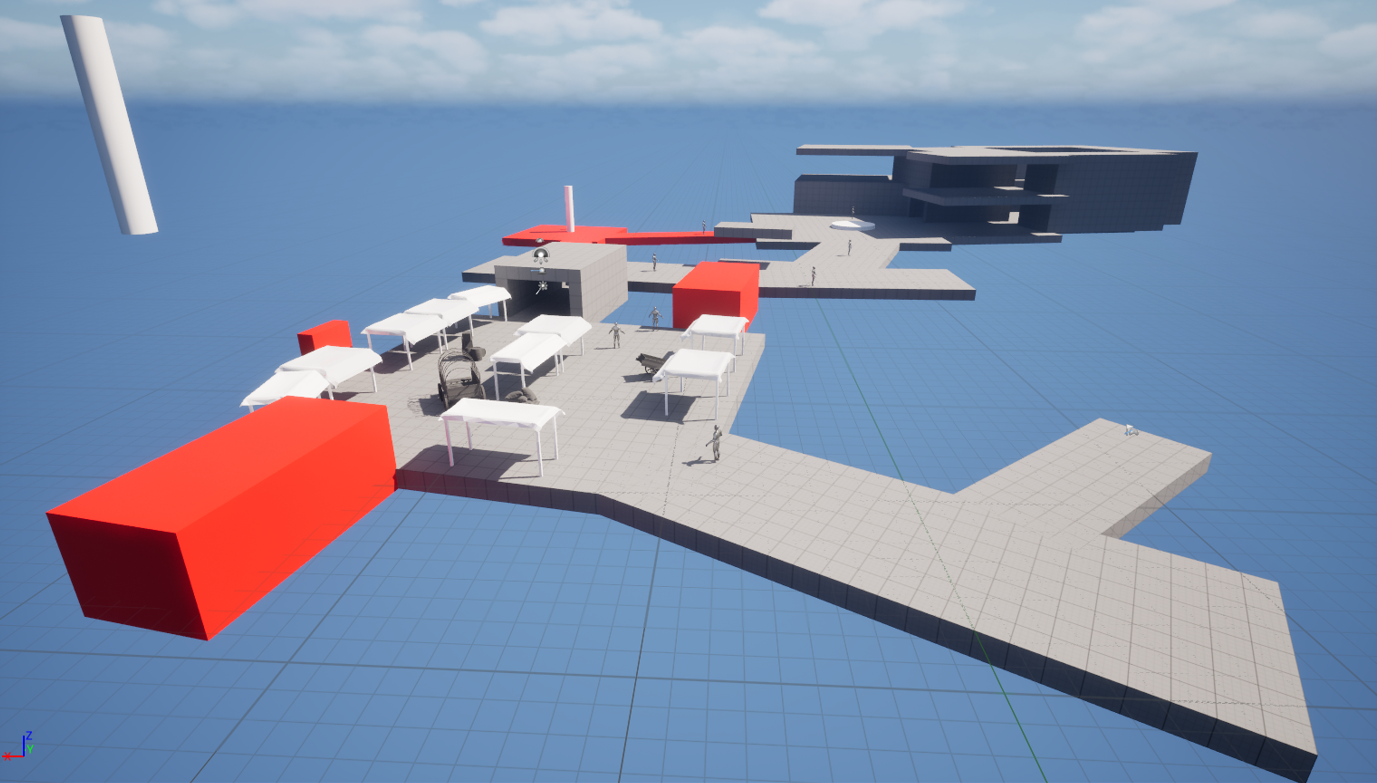
figuring out scale and major landmarks


major props/covers and hiding zones


